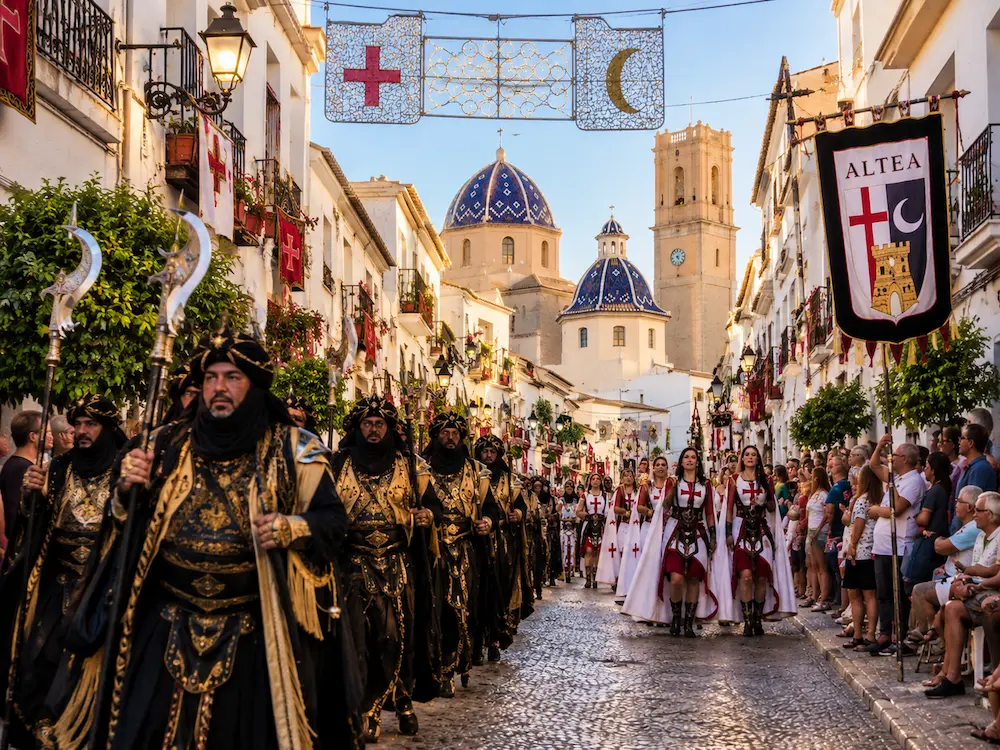
Every September, Altea‘s whitewashed old town trades its usual quiet rhythm for drums, brass bands, and streets packed with colour. The Fiestas Patronales de Altea, held in honour of the Santísimo Cristo del Sagrario and Sant Blai (San Blas), the town’s patron saint, run alongside the town’s Moros y Cristianos (Moors and Christians) celebrations — together forming the most important and most participative festival on Altea’s calendar.
In 2026, the main festivities take place from 26 to 30 September, with the Moros y Cristianos parades and events building through the final week of the month.
What Happens During the Fiestas
The festival blends religious tradition with theatrical spectacle, and the two run in parallel throughout the week:
- Religious events: the Ofrenda de Flores (Flower Offering) to the Virgen del Consuelo in Plaza José Mª Planelles, a solemn procession carrying the Santísimo Cristo through Altea’s old town, and the symbolic “Entrà de la Murta,” a traditional procession along Avenida La Nucía and Avenida Jaume I.
- Moros y Cristianos parades: elaborately costumed comparsas representing the historic “Moorish” and “Christian” factions parade through the old town and seafront, complete with embroidered costumes, standards, and their own marching music.
- Embajadas: theatrical staged negotiations between the two sides, considered the dramatic heart of the celebration.
- Mascletàs and fireworks: daytime firecracker displays and night-time fireworks light up the Mediterranean sky over the old town.
- Barracas: festival marquees, such as the Barraca Popular, open for food, drink and live music throughout the week — a good option for anyone wanting to experience the atmosphere without needing tickets to a formal event.
- Entrada de Bandas: a procession of marching bands from Plaza de la Cruz to Plaza José Mª Planelles, followed by the raising of festival flags and the official pregón (opening proclamation).
The celebrations have been held since 1979 and are recognised as a Fiesta of Autonomic Tourist Interest — one of the reasons the event draws visitors from well beyond Altea itself.
Why It’s Worth Planning Around
For residents and longer-term visitors on the Costa Blanca, Altea’s fiestas patronales sit at a good point in the calendar: late enough to avoid peak August crowds and heat, but while the town is still in full social swing before autumn quiets things down. The parades and processions are free to watch from the street, and the old town’s compact size makes it easy to catch several events in one evening on foot.
Anyone unfamiliar with Moros y Cristianos traditions will find Altea’s version a good, accessible introduction — the costumes and choreography are elaborate, but the atmosphere is informal and family-friendly, with the Club del Festeret and other daytime events aimed specifically at children.
Good to Know Before You Go
- Parking: the old town is largely pedestrianised during the fiestas, and parking fills up quickly on parade evenings — arrive early or use the Basseta-Centre car park area.
- Noise: mascletàs are loud by design. Those sensitive to noise, or travelling with very young children or pets, may want to view fireworks and firecracker displays from a distance rather than the main square.
- Dates can shift slightly year to year: while the 2026 dates are confirmed for 26–30 September, exact daily timings are typically only published in full closer to the event via the Ayuntamiento de Altea and local festival associations.