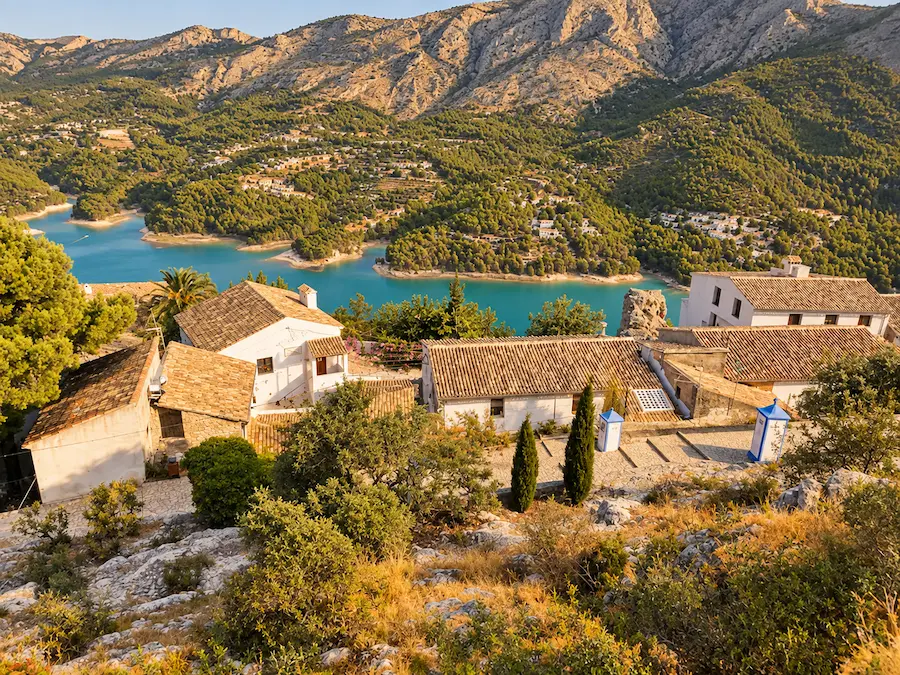
Located on a rocky outcrop above a turquoise reservoir in the Alicante hinterland, Guadalest (officially El Castell de Guadalest) draws day-trippers from across the Costa Blanca — and it’s easy to see why. A medieval castle ruin, a cluster of stone houses balanced on a cliff edge, and views over the Guadalest Valley combine to make it one of the most photographed villages in Spain. For anyone based in Altea, Callosa d’en Sarrià, Benidorm, or further along the coast, it’s a manageable half-day trip that feels a world away from the beach.
Where Is Guadalest and How to Get There
Guadalest sits roughly 25 kilometres inland from Altea, in the foothills of the Aitana mountain range. The drive from the coast takes around 30–40 minutes depending on the starting point, winding up through Callosa d’en Sarrià before climbing into the valley.
- From Altea or Calpe: Follow the CV-70 through Callosa d’en Sarrià, then the CV-755 up to Guadalest — around 35–40 minutes.
- From Benidorm: A similar route via Callosa d’en Sarrià, roughly 30 minutes.
- By bus: Local bus services run from Benidorm on certain days, though schedules are limited — a hire car or organised tour is the more reliable option for a same-day visit.
- Parking: There’s no parking directly in the historic centre. Paid car parks sit just outside the village, a short (but often steep) walk to the entrance.
Arriving early — ideally before 11am — makes a real difference. Guadalest is a compact village, and tour coaches from Benidorm and Alicante can fill its narrow streets by midday.
What to See in Guadalest
The Castell de Sant Josep (Alcozaiba Castle). The ruined castle that gives the village its name sits at the highest point, reached via a tunnel cut through the rock — the only way in. What remains dates largely from the 11th–13th centuries, rebuilt after a 1748 earthquake destroyed much of the original structure. The views from the top, over the reservoir and surrounding peaks, are the reason most visitors make the climb.
Casa Orduña. An 18th-century manor house turned museum, furnished largely as it would have looked when the Orduña family lived there. It offers a rare look at how a landed local family lived through several centuries, and the entrance fee typically bundles access to the castle ruins as well.
The Guadalest Reservoir (Embalse de Guadalest). The turquoise-green reservoir below the village, built in the 1960s, is what gives Guadalest its postcard-famous view. A short drive or walk along the CV-755 leads to well-known viewpoints looking back at the village perched above the water.
The bell tower and church. The freestanding bell tower, separate from the parish church, is one of Guadalest’s most-photographed structures — visible from the main viewpoint on the approach road.
Museums. Guadalest has an unusually high concentration of small, quirky museums for its size, including a Museum of Miniatures, a Salt and Pepper Shaker Museum, and a Torture Museum — a slightly eccentric side to a village otherwise defined by its medieval history.
Practical Tips for Visiting
- Time needed: 2–3 hours covers the village comfortably, including the castle climb and a stop at the main viewpoint.
- Footwear: The streets are cobbled and steep in places — comfortable shoes matter more here than in most Costa Blanca towns.
- Combine with Callosa d’en Sarrià: Many visitors pair Guadalest with a stop at the Algar waterfalls near Callosa d’en Sarrià on the same route inland, making a fuller day out of the trip.
- Food: The village has a handful of restaurants and cafés with terrace views over the valley — reservations aren’t usually necessary outside peak summer weekends.
- Best light for photos: Late morning to early afternoon gives the clearest light on the reservoir’s colour; sunset from the village looking back toward the coast is also popular.
When to Visit
Guadalest is a year-round destination, but spring (April–June) and autumn (September–November) bring the most comfortable walking conditions and noticeably thinner coach-tour crowds than peak summer. Winter visits are quieter still, though some of the smaller museums keep reduced hours outside the main season — worth checking ahead if a specific museum is the priority.
For those planning a wider loop through the Costa Blanca’s inland villages, Guadalest sits naturally alongside Sierra Bernia and the region’s other natural parks as part of a day spent away from the coast — and it’s a strong addition to any best places to visit itinerary for first-time visitors to the area.