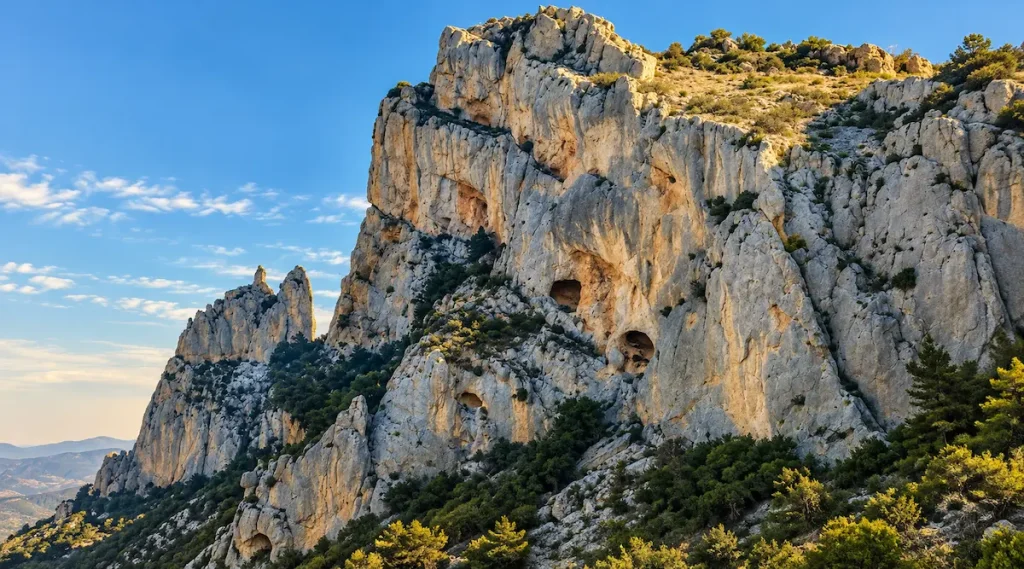
Cabezón de Oro (Cabeçó d’Or) rises just inland from Alicante, a limestone massif reaching 1,209 metres above Busot and Aigües. It’s best known for two very different things: the Cuevas del Canelobre, a show cave with a chamber over 70 metres high, and the mountain above it, which has become one of the most developed climbing and hiking areas in the province, with more than 500 bolted climbing routes and a summit walk that takes most of a day.
Cabezón de Oro at a Glance
Summit: 1,209 m, marked by a geodesic vertex
Range: Sierra del Cabeçó d’Or, Alacantí comarca
Nearest towns: Busot and Aigües
Main cave: Cuevas del Canelobre, with a chamber over 70 m high
Protected status: a ZEPA (Special Protection Area for Birds), home to golden eagles
Main walking route: PR-CV 2, roughly 10.5–11 km circular, about 4 hours, +820–830 m elevation gain
Cuevas del Canelobre
The Cuevas del Canelobre sit on the CV-776 road toward Jijona, about 3 km from central Busot. The main chamber is over 70 metres high and holds large limestone formations, reached by stairs from the original cave entrance. The caves also host a vía ferrata infantil, a roughly 35 m beginner climbing route graded K1, suggested for children aged 8 and up with some climbing experience, descending either back down the route or by a 30 m rappel.
Hiking to the Summit
The PR-CV 2 is the main route to the top, a circular walk of about 10.5–11 km with roughly 820–830 m of elevation gain, graded medium-high for the physical effort involved. Most guides recommend starting at Pla de la Gralla, a parking area at a sharp bend on the access road to the caves, and walking the loop counterclockwise.
Along the way, the route passes Casa Polset, a saddle at about 950 m used as a rest stop, and features with names like Racó de Seva, Esquenall de l’Ase and the “Escalón Hillary,” a rock step fitted with metal grips. Near the summit are the ruins of the Casa del Compte. From the top, the view takes in the Alicante coastline, and the mountain is home to birds of prey including the eagle owl, peregrine falcon and short-toed snake eagle.
Climbing on the Cabeçó d’Or
The mountain’s west face is Jurassic limestone, and local climbing clubs have developed it into one of the region’s major climbing areas, with routes described as numbering in the hundreds across several sectors:
- Cuevas: over 30 routes, some over 30 m, near the cave entrance
- Galia: around 10 routes of roughly 20 m
- Tocayo: 46 routes up to 25 m
- Jabugo, Torreón and Circo: over 30 routes combined, of varied difficulty
The Club de Deportes de Montaña y Escalada de Busot has been central to developing the routes and ferratas here.
Busot, the Nearest Town
Busot sits at the foot of the mountain and is the natural base for a visit. Its own sights include the Castillo de Busot, the Ermita de San José, the Parroquia de San Lorenzo Mártir, the Torre de Cabrafich and the Museo de Música Étnica de Busot. The town’s main fiesta, Festes de Sant Llorenç, falls in September, and Busot also hosts an annual mountain-bike event, the Marcha BTT Coves del Canelobre, around the same time of year.
Getting There
Busot is inland from Alicante, reached by the CV-776, with the Cuevas del Canelobre and the Pla de la Gralla trailhead a short drive further along the same road. A car is the practical way to get here. For other inland day trips from the coast, see the guides to Guadalest and the Vall de Gallinera, and for natural areas across the wider region, the guide to natural parks on the Costa Blanca.