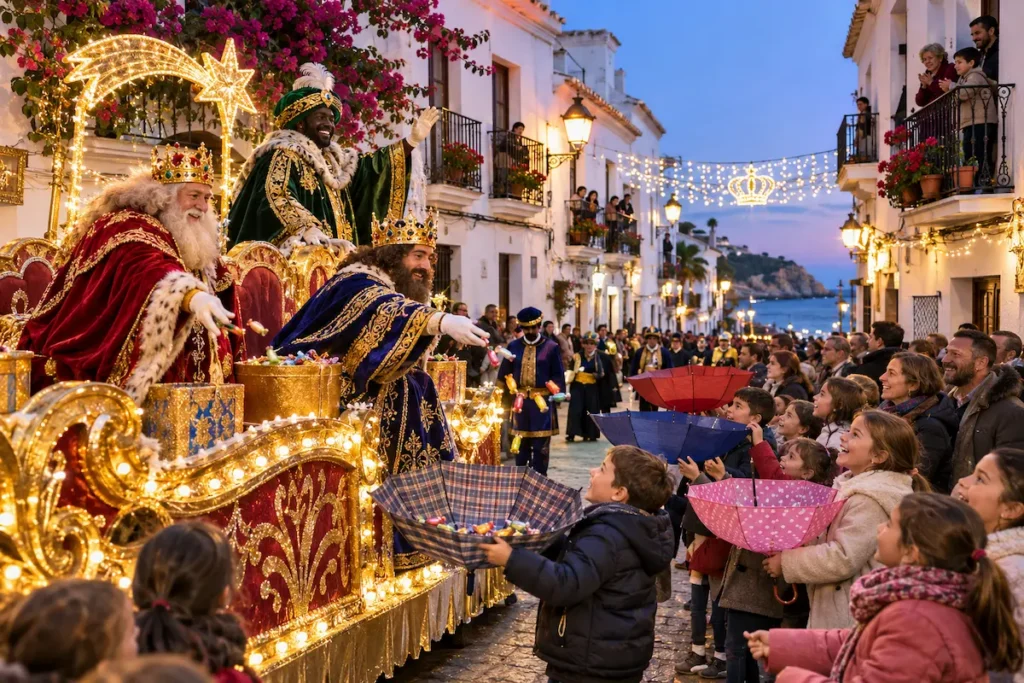
On the evening of 5 January, towns across the Costa Blanca stop for the Cabalgata de Reyes, the Three Kings parade. Melchior, Gaspar and Balthazar arrive by boat, on camels or on floats and throw sweets into the crowds. That night children leave out their shoes for gifts. For Spanish families this, rather than Christmas morning, is the biggest night of the festive season. In 2027 the parades fall on Tuesday 5 January, and Wednesday 6 January is a public holiday.
This guide covers what happens, how the main Costa Blanca towns ran their parades in January 2026, and how to plan around the 2027 edition. Exact 2027 start times and routes are normally published by each town hall in mid to late December. Times below are the confirmed 2026 arrangements, verified November 2026.
What Is the Cabalgata de Reyes?
The Cabalgata de Reyes is a procession held on the evening of 5 January to welcome the Three Wise Men, known in Spain as the Reyes Magos. Floats, bands, dancers and costumed pages follow the Kings through town, and sweets are thrown to the crowds. That night children leave shoes out for the Kings to fill with presents.
The parade is the climax of a run of Christmas events. In the days before it, most towns host a Cartero Real (Royal Postman) or a Royal Camp where children hand over their letters to the Kings. The following morning, 6 January, is when most Spanish children open their main presents.
For visitors and new residents, three things are worth knowing:
- It’s an evening event. Most Costa Blanca parades start between 17:00 and 19:00, so arrive in daylight to find a spot.
- It’s built for children. Pages throw sweets constantly. Children at the kerb often bring a bag, or an upturned umbrella, to catch them.
- It’s very local. Every town runs its own parade, from Alicante’s large city procession to small village cabalgatas, and each has its own character.
Key Dates for Reyes 2027
The dates are fixed every year. Only the times and routes change.
Cabalgata de Reyes: Tuesday 5 January 2027, evening
Día de Reyes (Epiphany): Wednesday 6 January 2027, a public holiday across the Comunitat Valenciana
Letters and Royal Camps: usually the last days of December and the first days of January, varying by town
Because 6 January 2027 is a Wednesday holiday, expect banks, offices and many shops to close that day. Supermarkets in tourist areas often open shorter hours. Bus services usually run a holiday timetable, so check before travelling if you rely on public transport on the Costa Blanca.
Town-by-Town: How the Parades Run
These are the arrangements each town confirmed for January 2026, the most recent edition. Several were changed on the day because of rain. Those changes are included because they show how towns handle bad weather, which matters for planning in 2027.
Alicante
Alicante holds the biggest parade on the Costa Blanca. In January 2026 it drew more than 55,000 people, with over 1,300 participants and around two dozen floats.
Start: 19:00 on 5 January
Route (2026): from Avenida de la Estación, beside the Palacio Provincial, to Plaza del Ayuntamiento. The starting point was extended in 2026; it previously began at Plaza de los Luceros.
Before the parade: the Kings were welcomed at around 17:00 at the Escaleritas de la Reina in the port. Around a thousand children gathered there for photos.
Reserved seating: around 8,000 chairs were sold along the route for 2026. 60% went online through Vivaticket and 40% in person at the bullring ticket office. Sales opened on 26 December at 10:00.
Royal Camp: in Plaza de Gabriel Miró, from 26 December to 4 January, with appointments booked through the city council’s online booking system.
If you’re making an evening of it, the old town below Santa Bárbara Castle is a short walk from the route. The Alicante festivity calendar covers the city’s wider Christmas programme.
Benidorm
Benidorm’s parade is planned for around 1,000 participants and a dozen floats. It runs in two halves. The first is lighter and features characters from children’s films and TV. The second retells the Nativity story to a six-part symphonic suite composed by Francisco José Rovira Peretó.
Start (planned 2026): 18:00 on 5 January, from Parque de Elche
Route (planned 2026): Avenida de Los Almendros, Calle Marte, Calle Venus, Calle Ruzafa, Calle Herrerías, Plaza SSMM Reyes de España and Parque de l’Aigüera, finishing at the Julio Iglesias Auditorium. A multimedia show and fireworks follow there, then the Kings hand out gifts to children.
What actually happened in 2026: the parade was moved indoors to the Palau d’Esports because of rain. Doors opened at 17:00 and free buses ran to the venue.
The planned route runs close to Benidorm’s old town. The Benidorm festivity calendar lists the city’s other seasonal events.
Altea
Start (2026): 18:00 on 5 January
In 2026 Altea kept its 18:00 start but moved the parade indoors to the Palau dels Esports because of rain. In a dry year the parade runs through the town, and an evening in the old town afterwards pairs well with it. The full year’s events are in the Altea festivity calendar.
Calpe
Planned route (2026): from Plaza Colón to the Iglesia Virgen de las Nieves, starting at 17:00
In 2026 Calpe postponed the parade from 5 to 6 January because of the forecast, keeping the 17:00 start and the same route. The Calpe festivity calendar covers the town’s wider Christmas events.
Moraira and Teulada
In 2026 the joint Teulada-Moraira parade was moved from 5 January to the morning of 6 January, between 11:00 and 12:00, because of rain. On the evening of 5 January the Kings still made smaller appearances with gift handouts: at 17:00 at Espai La Senieta in Moraira, and at 18:00 at the Auditori Teulada Moraira. The Moraira events calendar lists the town’s other dates.
Jávea
In Jávea the Kings traditionally arrive by boat at the port, where families gather along the harbour. The parade then moves up towards the old town. The 2026 parade was cancelled because of the weather. Instead, the Kings greeted children between 17:00 and 18:30 at the parish churches of San Bartolomé and Nuestra Señora de Loreto. The Royal Camp and letter collection on 3 January at the Parroquia de la Mar went ahead. If the 2027 arrival goes to plan, Jávea’s port is the place to be.
Dénia
Dénia cancelled its 2026 parade because rain was forecast all day. The Kings received children at the Centro Social between 16:30 and 20:30 instead. Dénia’s wider event programme is in the Dénia festivity calendar.
Villajoyosa
Villajoyosa’s Kings arrive on camels. At the town’s 2024 parade, which set off at 18:30, pages handed out chocolate bars to the children. That suits a town with its own chocolate-making tradition, covered in the Villajoyosa guide. The procession finished at the Finca La Barbera. A separate parade also ran through the La Cala area.
If It Rains
January is the Costa Blanca’s quiet season, and rain on 5 January is not unusual. In 2026 it disrupted parades in at least six towns. Altea and Benidorm moved indoors, Calpe and Teulada-Moraira postponed to the next day, and Dénia and Jávea cancelled. (What January weather is typically like is covered in CBD’s year-round guide.)
Changes are usually announced on the day, often only a few hours before the start, through each town hall’s website and social media. If the forecast looks doubtful, check the ayuntamiento’s official channels before setting off.
Traditions to Know
Shoes by the door. On the night of 5 January children leave their shoes out, often with something for the Kings and their camels, such as water or a snack. Presents appear by morning.
Carbón. Children who’ve misbehaved are jokingly given carbón dulce, a black sugar sweet made to look like coal. Bakeries and sweet shops sell it in the days before Reyes.
Roscón de Reyes. The ring-shaped sweet bread of 6 January is topped with candied fruit and often filled with cream. A small figure and a dried bean are hidden inside. Finding the figure is good luck. Tradition says whoever finds the bean pays for next year’s roscón. Bakeries take advance orders, and the best sell out, so order a few days ahead.
Sweets at the parade. Pages throw sweets throughout the parade. Children near the front collect the most, which is why families arrive early and claim the kerb.
Practical Tips for 5 January 2027
- Arrive early. For Alicante and Benidorm, give yourself at least 45 minutes before the start to find a spot. In smaller towns 20 minutes is usually enough.
- Avoid driving into the centre. Parade routes are closed to traffic from late afternoon, and parking near them fills fast. Walk or use public transport where you can.
- Bring layers. Evenings in early January are cool once the sun goes down, especially if you’re standing still for an hour or more.
- Bring a bag for the sweets, and keep small children at the front where pages can see them.
- Check the programme in late December. Town halls usually confirm times, routes and Royal Camp dates in the second half of December.
- Plan for 6 January. It’s a public holiday, so stock up on 5 January if you need anything.
To explore more of the region beyond Reyes, see the town guides for Alicante and Benidorm.