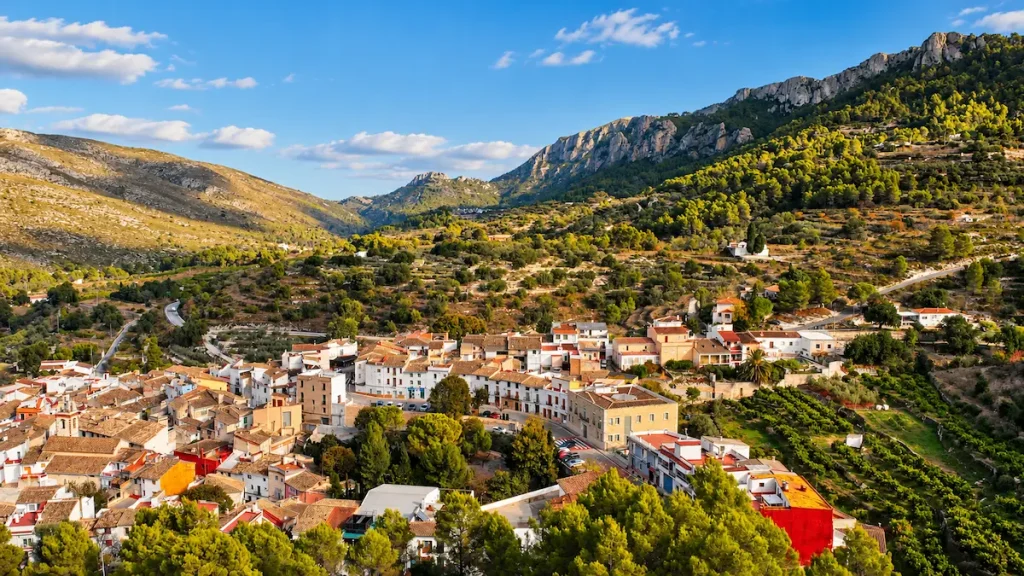
Most of the Costa Blanca’s interior is known for almond blossom in January and February. The Vall de Gallinera, a narrow valley in the Marina Alta, has the opposite season to plan for: cherry blossom, usually in March, when its terraced orchards turn the valley white between eight small villages and the Serra Foradada ridge. The rest of the year, the valley is a quiet detour through some of the least-visited parts of inland Alicante.
Vall de Gallinera at a Glance
Location: Marina Alta, inland from Dénia and the Jalón Valley
Villages: eight — Benirrama, Benialí, Benissivà, Benitaia, La Carroja, Alpatró, Llombai and Benissili
Population: 582 as of 2016, down from a peak of 2,324 in 1910, according to the valley’s own tourism site
Highest peak: La Safor, 1,013 m
Best known for: the Ruta dels 8 Pobles walking route and cherry blossom in March
Castle: Castell de Gallinera, near Benirrama, once the seat of a feudal lordship
A Valley of Eight Villages
The valley takes its name from La Foradada, “the perforated rock,” a description of the ridge that closes it in. According to the valley’s own tourism history, it has been settled since Iberian times, with farming hamlets established under Andalusian rule, a feudal lordship centred on the Gallinera castle after the Christian conquest of 1244–1245, and a period under Morisco rule that ended with the 1609 expulsion. The valley was largely repopulated by settlers from Mallorca in the 17th century — the roots of many of today’s village names.
Of the eight villages, Llombai is now uninhabited. Population figures from the valley’s own tourism site show the scale of the decline: 2,324 residents in 1910, 1,107 by 1970, and 582 by 2016 — the familiar story of inland Spain’s rural depopulation.
The Ruta dels 8 Pobles
The valley’s best-known walk is the Ruta dels 8 Pobles, a roughly 14 km linear route along agricultural tracks connecting all eight villages, from the Font de la Mata in Benirrama to the Font de la Mata in Benissili. It’s graded medium difficulty, and since it’s linear rather than circular, walkers commonly do a shorter stretch rather than the whole route.
The path runs beneath the Serra d’Almudaina, with the Castell de Gallinera visible from parts of the route looking toward the coast. For a longer loop, several walking guides point to a roughly 20 km alternative through five villages on the north side of the neighbouring Serra d’Almudaina — Benimarfull, Benillup, Almudaina, Benialfaquí and Planes — just outside the valley itself.
Cherry Blossom Season
The valley is one of inland Alicante’s main cherry-growing areas, and its orchards blossom white across the terraces and hillsides, typically in the second half of March, though the exact timing shifts each year with the winter and early-spring temperatures. Local guides point to the stretch between Benialí, Benissivà and La Carroja as one of the best places to see it, and recommend early morning for the clearest light.
The harvest itself comes later, in June, when the valley holds its Fiesta de la Cereza (Cherry Festival), with the community gathering to bring in the crop and celebrate with music and local food built around the fruit.
Castell de Gallinera
The Castell de Gallinera sits near Benirrama and was the historic centre of the valley’s feudal lordship. A chapel stood within its walls during the Morisco period. It’s a ruin today rather than a restored monument, but it’s visible from parts of the Ruta dels 8 Pobles and gives the valley views their backdrop.
When to Visit
March: cherry blossom, the valley’s best-known season
June: the Fiesta de la Cereza, when the cherries are harvested
Any time of year: the Ruta dels 8 Pobles and the valley’s quieter walking routes
Getting There
The Vall de Gallinera sits inland from Dénia and the Jalón Valley, reached by mountain roads through the Marina Alta. It’s a destination for a car rather than public transport. For other inland day trips from the coast, see the guide to Guadalest, and for the coastal towns nearby, the Dénia hub page and museums in Dénia cover what’s on the coast itself.