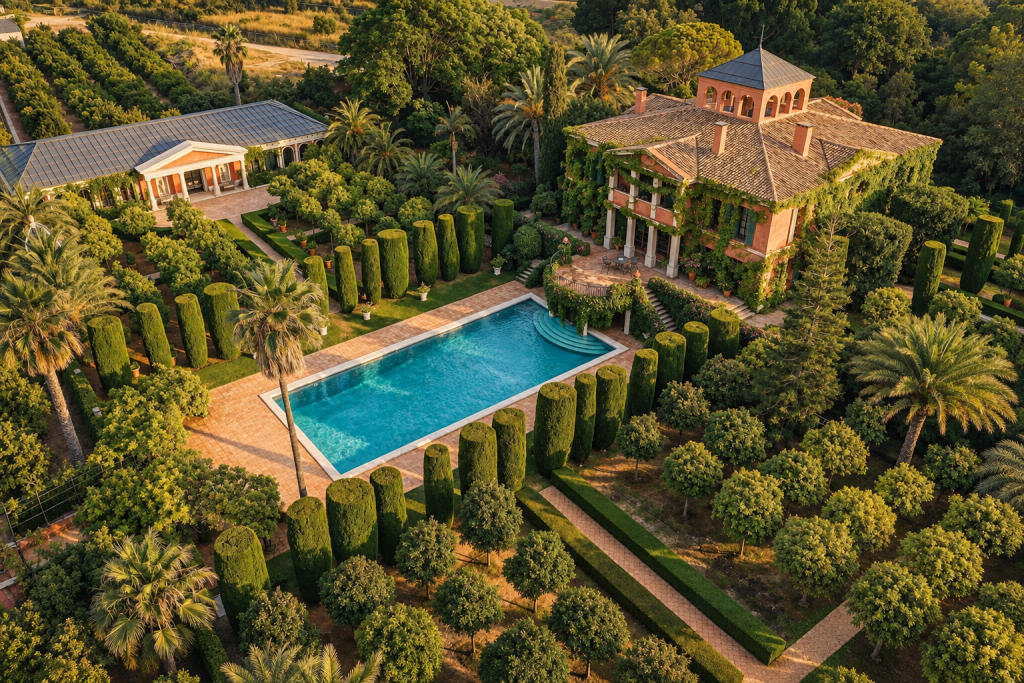
A few minutes inland from the coast, in the countryside outside Pedreguer, five hectares of Mediterranean garden hold over 700 plant species, a century-old cork oak and trencadís mosaic sculptures by a local artist. The Jardín de l’Albarda opened as a private family garden in 1990 and still opens to the public every morning, with no booking needed.
Jardín de l’Albarda at a Glance
Location: Urbanización Muntanya de la Sella, Pedreguer — about 10 minutes from Dénia and 15 minutes from Jávea
Size: about five hectares
Species: over 700, mostly native
Hours: every day, 10:00–14:00, no reservation needed; also 18:00–21:00 from 15 June to 15 September
Admission: donation-based, from €4 to €9 depending on age and day
Run by: FUNDEM, a Mediterranean conservation foundation
How the Garden Began
The garden was created by Enrique Montoliu, a chemical engineer and businessman, who bought farmland in the Albardanera area of Pedreguer in the 1980s, planted with pines, oranges and lemons. He originally planned a second home with a private exotic garden. The house and garden were completed in 1990, and plant expert Juanjo Todolí advised him on opening it to the public, starting with just one Saturday a month.
The name comes from the Albardanera area itself, which locals link either to burdock (“llapassa”) or to the twin peaks of the nearby Sella mountain, said to resemble a horse’s saddle (albarda).
A Garden of Gardens
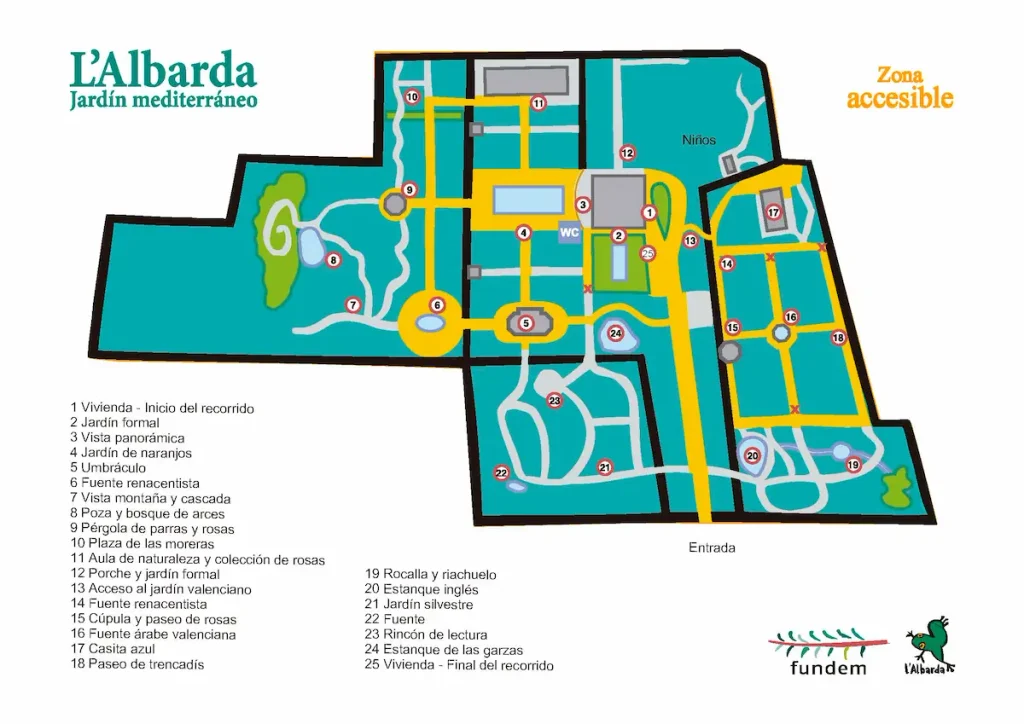
L’Albarda is laid out as several distinct gardens rather than one continuous landscape: a formal Renaissance-style garden near the house, a traditional Valencian garden with Arab influences and orange trees, a Mediterranean forest, and a riverside forest. Architectural features include a neoclassical house, an iron-framed “umbracle” for tropical plants, an artificial rockery with a waterfall, and a plant amphitheatre that works as a greenhouse.
Scattered through the grounds are trencadís mosaic animal sculptures by the artist Cento Yuste, a distinctive touch among the planting.
What Grows There
Highlights among the garden’s 700-plus species include myrtle, boxwood and orange trees in the Arab-style section, Portuguese oak, holm oak, and an estimated 80-year-old cork oak — the oldest tree on site. The collection also includes strawberry tree, bay laurel, European fan palm, araucarias and a dedicated rose collection, along with the rare coastal endemic Silene hifacensis.
The garden’s design won the Magister de Paisajismo prize from the Universitat Politècnica de València in 2002, and it has been listed among the 150 most beautiful gardens in the world in a Canadian guide curated by Ulysse.
FUNDEM
Montoliu founded FUNDEM in 1996 as a non-profit dedicated to conserving Mediterranean flora and fauna, modelled loosely on the UK’s National Trust. The foundation buys land across Spain for conservation groups to protect, with sites including Mas del Peraire, the Vall de Gallinera, the Serra de Bèrnia and the Marjal d’Almenara. The Jardín de l’Albarda is its best-known public-facing project.
Visiting
The garden is open every day from 10:00 to 14:00, with no reservation required, and extends to 18:00–21:00 in summer (15 June to 15 September). Admission is donation-based and varies by age and day:
Monday to Friday: €7 general, €4 junior (ages 7–13), free under 6
Saturdays, Sundays and holidays: €9 general, €5 junior, free under 6
Guided tours are available for groups of at least 10 people, by reservation, in Spanish, Valencian or English. Much of the garden is wheelchair accessible, and dogs are allowed on a leash.
Getting There
The garden sits inland between Dénia and Jávea, making it an easy stop for anyone staying on that stretch of coast. For other inland destinations nearby, see the guides to Cap de Sant Antoni & Els Molins and the Vall de Gallinera, and for the coast itself, museums in Dénia and top things to do in Jávea.