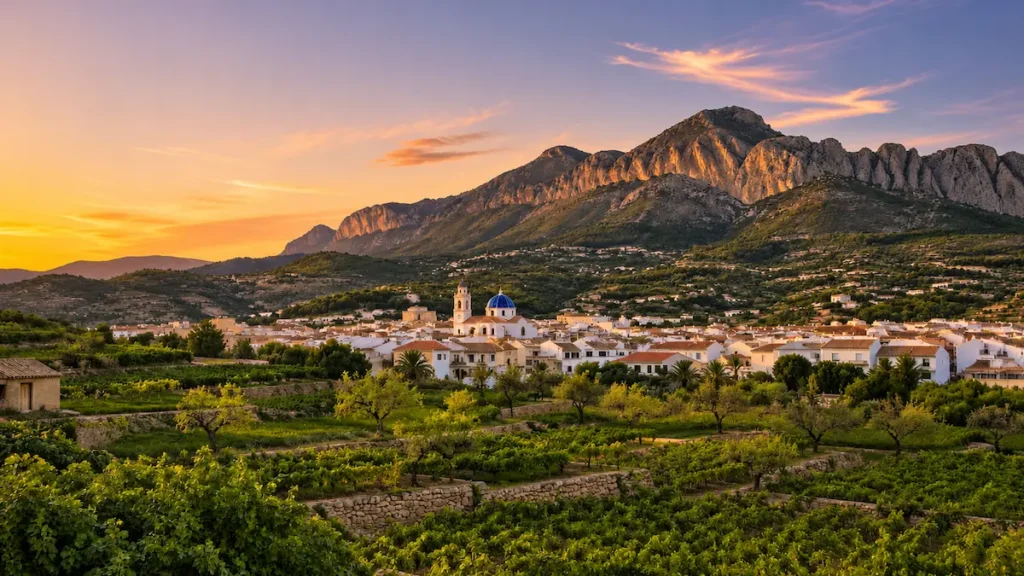
The Jalón Valley, known locally as the Vall de Pop or Vall de Xaló, is the green inland valley behind Jávea, Moraira and Benissa. It is a landscape of vineyards, almond and carob terraces and small white villages, threaded together by the Xaló-Gorgos river. It’s best known for three things. There’s the Saturday rastro (flea market) in Xaló, the Moscatel wines of the valley’s cooperative, and, every late winter, the almond blossom.
This guide covers the valley’s villages, the market, the wineries and what’s worth seeing, along with an honest look at the blossom season. Opening times and seasonal details were verified in November 2026.
Where Is the Jalón Valley?
The Vall de Pop is an inland valley in the Marina Alta, just behind the coast between Benissa and Jávea. The valley takes its name from the Cavall Verd mountain, also known as the Serra del Pop. It sits between the Penyal and Carrascal ranges, and the Xaló-Gorgos river runs through it before flowing out to the sea at Jávea.
The local tourism body, the Mancomunitat de la Marina Alta, lists six villages in the valley: Xaló (Jalón), Llíber, Alcalalí, Parcent, Murla and Benigembla. Xaló is the largest and the natural starting point. The others are a short drive apart along the valley road.
The valley is close enough to the coast for a half-day trip from Moraira, Jávea or Benissa, and it has a very different feel: quieter, agricultural and noticeably more Valencian.
The Saturday Rastro in Xaló
Xaló’s Saturday rastro is one of the best-known flea markets in the Marina Alta. It runs every Saturday morning along the banks of the River Gorgos, which is usually dry. The market stretches about a kilometre through the town.
When: every Saturday morning, from roughly 9:00–10:00 until 14:00
Where: along the banks of the Gorgos river through Xaló
Size: more than 200 stalls on a normal Saturday. The market started with just 14.
What’s on sale: antiques and furniture, art, clothing, ceramics and kitchenware, leather goods, jewellery, minerals and fossils, artisan food and souvenirs
Alongside the rastro there’s a farmers’ produce market, the Mercat de la Terra, selling fresh fruit, vegetables, drinks and snacks. Bars and cafés line the street opposite the stalls.
Parking: spaces inside the town fill early. Most visitors use the unpaved lots beyond the market, where an attendant often collects a small fee of around €2, so bring coins. Arrive before 10:00 for the best choice of parking and stalls.
If you enjoy the rastro, CBD’s guides to the markets in Moraira and Benissa’s old town and market cover the nearest weekly markets on the coast.
Wine in the Valley: Moscatel and Bodegas Xaló
The Vall de Pop is wine country. Its vineyards grow mainly Moscatel de Alejandría, the sweet white grape behind the region’s mistela (a fortified sweet wine), and the red Giró variety.
The main producer is Bodegas Xaló, a cooperative founded in 1962 by 14 local farmers. Today it has around 390 member growers and roughly 400 hectares of vineyards across the valley. Its 2025 harvest brought in about a million kilos of Moscatel and Giró. The cooperative makes mistelas, whites and reds, including the well-known Bahía de Dénia label.
Visitors can tour the winery and book a tasting of four wines plus a mistela or vermouth, served with local sausage and cheese. A second winery in Xaló, Bodegas Riko, also offers tours. Both are especially lively around the grape harvest in late summer and early autumn.
The valley’s grape-growing past is still visible in its riuraus: arched porches where Moscatel grapes were once laid out to dry into raisins. Parcent has good examples.
Almond Blossom: When to Go and What to Expect
Almond trees in the inland Costa Blanca usually start to flower from mid-to-late January, with the main bloom through February. Higher and cooler spots carry on into March.
The Jalón Valley used to be one of the region’s best-known blossom spots, but in recent years it has changed. Xylella fastidiosa, a bacterial disease of almond trees, has spread through the province. Around 285,000 trees have been uprooted in Alicante province since it appeared. There is no cure, and the only control is to remove infected trees and any others within 100 metres. Around Alcalalí, local accounts describe almost no blossom in early 2026 where it was once abundant.
There are still flowering trees in the valley, but anyone travelling specifically for blossom should keep expectations realistic. The lanes around Relleu, near the Pasarela de Relleu walkway, were in full flower in 2026. The valleys around Guadalest are also a strong alternative. For spring, the Vall de Gallinera’s cherry blossom follows on later, around late March to mid-April.
The Almond Blossom Walk in Alcalalí
If you do want to walk among the almond terraces, Alcalalí has an easy circular route of about 3.8 km with no significant climbing. It starts at the village’s Ecoparque, crosses the Gorgos river and continues to the hermitage of Sant Joan de Mosquera before looping back. A longer 6.6 km variant heads towards the Penya Talai, with just over 100 metres of climbing. Both routes are listed on Wikiloc as “Ruta almendros en flor”.
FESLALÍ: Alcalalí’s February Festival
Every February, Alcalalí runs FESLALÍ, a month of weekend events combining walks, workshops, markets and food. In 2026 it ran from 1 to 22 February. It began as an almond blossom festival, but as the almond trees have declined it has shifted its focus to the carob, the valley’s other traditional tree crop. The 2027 programme is published on the Alcalalí town hall website (alcalali.es).
What to See Around the Valley
Alcalalí’s Medieval Tower
The Torre de Alcalalí is a five-storey tower built in the late 14th century, when the valley faced raids by pirates and bandits. The noble Ruiz de Lihory family, who governed the village until 1837, later added a palace beside it, linked by a drawbridge. The town hall restored the tower after acquiring it in 1992.
Inside, the first two floors are a museum. The third floor has graffiti and engravings from the 16th and 18th centuries showing local life, and the top is a viewpoint over the valley. It’s on Plaça de l’Ajuntament. Call 966 482 024 for current opening times.
Coll de Rates
The Coll de Rates mountain pass above Parcent is the classic viewpoint over the valley, best at sunset. It’s also one of the most famous road-cycling climbs in the region, covered in CBD’s Costa Blanca cycling guide.
Murla and Benigembla
At the quieter, upper end of the valley, Murla’s parish church of Sant Miquel Arcàngel is built into the remains of a castle. Benigembla has the Ribàs Botanical Park on the banks of the Xaló-Gorgos river.
The Sierra de Bernia
The Bernia ridge rises at the southern edge of the valley, between Xaló and the coast. Its walks and old fort are covered in CBD’s guide to the Sierra Bernia.
Planning Your Visit
- Best day: Saturday, for the rastro, then a winery visit or lunch in Xaló.
- Best season: spring and autumn for walking and the harvest, or February for the blossom and FESLALÍ, keeping the caveats above in mind.
- Getting there: the valley is best reached by car. Public transport is limited, so check CBD’s guide to getting around the Costa Blanca before relying on it.
- Combine it with: Benissa’s old town on the way back to the coast, or Moraira for the evening.