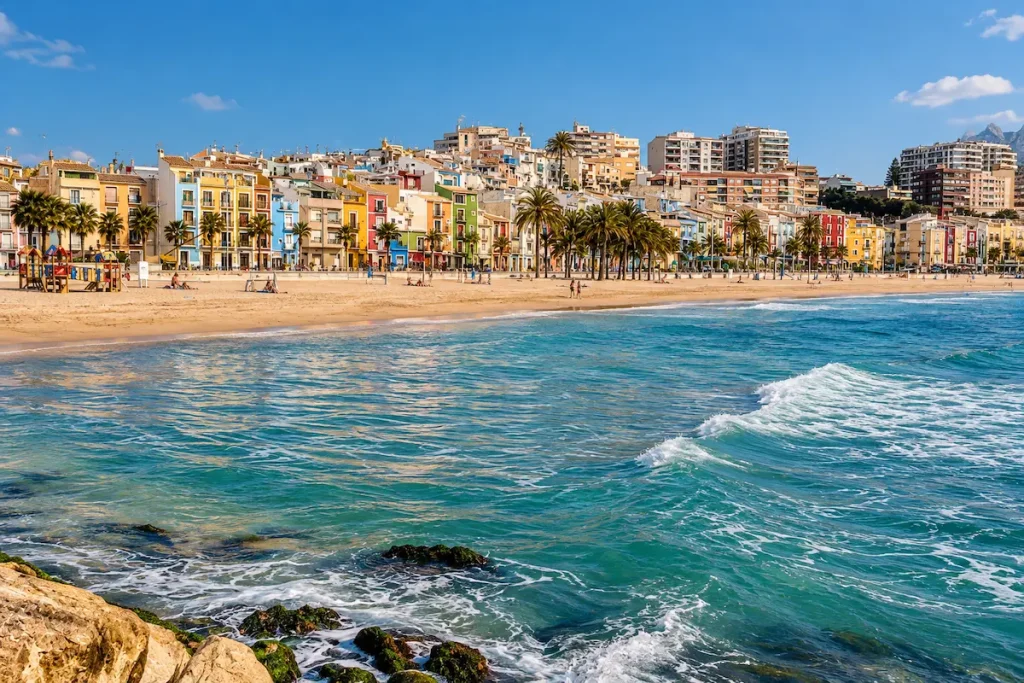
Villajoyosa has 13 beaches and coves along 15 km of coastline, and six of them flew the Blue Flag in 2026: Bol Nou, Centre, La Caleta, Paradís, Varadero and El Torres. That is the most Blue Flags of any municipality in the Marina Baixa, and it covers everything from a 1.3 km town beach with a promenade to small pebble coves under pine-covered rock. Here is what each one is like, which suits which kind of day, and what to know before going.
Villajoyosa Beaches at a Glance
The town’s beaches split into three groups: the flat, sandy urban stretch in the middle, coves and beaches south toward Alicante, and rockier coves north toward Benidorm. The essentials, checked in September 2026:
Beaches and coves: 13
Coastline: 15 km
Blue Flag 2026: Bol Nou, Centre, La Caleta, Paradís, Varadero and El Torres, plus the Club Náutico marina
Certification: the town’s official tourism site states that all its beaches hold ISO 9001 and ISO 14001 certification
Nearest airport: Alicante–Elche, roughly an hour by road according to local guides
For the town itself, including the old quarter, the chocolate museum and the Roman ruins, see the complete guide to Villajoyosa and the Villajoyosa hub page.
The Six Blue Flag Beaches
The Blue Flag beaches are the easiest to visit: they have lifeguards in season, tested water and the best facilities.
Playa Centro
The main town beach is a long, sandy stretch of over 1,300 metres running along the seafront, with the painted fishermen’s houses behind the promenade. It is the natural choice for families and for anyone without a car, because it sits directly in the town centre.
Each summer an accessible bathing area is set up beside the Club Náutico, in the Basseta l’Oli area. In 2026 it runs from 15 June to 15 September, from 10:00 to 17:00, and is closed from 27 to 30 July for the local festivities. Sunbed and parasol hire and a water park operate on the beach in summer, according to the town hall’s 2025 season announcement.
Paradís
Paradís (Playa del Paradís) is the town’s southern beach, on the Alicante side of the centre, roughly a kilometre from the middle of town according to local guides. The official tourism site describes it as an open beach that has kept its natural setting, with fine golden sand, some gravel and palm trees, and easy access. Sunbeds, parasols and seasonal beach bars operate here, and its car park is the usual starting point for reaching neighbouring Bol Nou on foot.
Bol Nou
Bol Nou is a small beach of fine pebbles and sand, two kilometres from the town centre on the road toward Alicante. It sits beside Paradís, and a stairway from the Paradís car park leads down to it, so parking there and walking is easier than looking for space nearer the cove. The rocky seabed makes it a good spot for snorkelling. The town hall lists lifeguards, toilets and foot showers here, alongside its Blue Flag.
La Caleta
A little over two kilometres from the centre, again toward Alicante, La Caleta is a small cove of fine pebbles and gravel. It is one of the six Blue Flag beaches for 2026, and it suits people who want a calmer swim than the town beach offers.
Varadero
Varadero is the widest of three coves beside the fishing port, and it takes its name from an old shipyard. The official site calls it ideal for families and good for snorkelling or sunbathing. It is close to the old town, so it is easy to combine with a walk around the harbour.
El Torres
El Torres is a semi-urban beach of gravel and sand two kilometres from the centre, on the Benidorm side. It is surrounded by greenery, and the coastal path toward Racó del Conill starts here (see below).
Quieter Coves Worth Finding
Beyond the Blue Flag beaches, the coastline breaks into smaller, wilder coves. Most are stony rather than sandy, so water shoes help.
- Estudiants and Tío Roig: two more coves in the Varadero complex beside the fishing port. Estudiants is a narrow cove of fine pebbles and gravel with clear water, and Tío Roig is a rocky, gravelly cove with open sea.
- Les Puntes del Moro: a quiet, semi-urban pebble cove 210 metres long, near the Malladeta hill. It has a beach bar in summer and is popular for snorkelling.
- Racó del Conill: a pebble-and-sand cove 160 metres long, three kilometres from the centre toward Benidorm and divided in two by a rocky outcrop. The official site describes it as one of the coves with the longest tradition of nudism in the Marina Baixa. Parking is available.
- L’Esparrelló: a clear-water cove that the tourism site lists as suitable for nudism.
- El Xarco: a pebble, gravel and sand beach more than 3.5 km from the centre toward Alicante, with snorkelling spots and picnic areas. One end is pet-friendly, which makes it the beach the official tourism site highlights for visitors with dogs.
- Carritxal: a pebble and rock beach beside a ravine, described as hard to reach, rarely visited and surrounded by vegetation. It is one for experienced walkers, not a casual beach day.
Which Beach for What
- Families with young children: Playa Centro, for the promenade, facilities and the accessible bathing area, or Varadero for a smaller cove beside the port
- Snorkelling: Bol Nou, Varadero, Les Puntes del Moro and El Xarco. For wider ideas, see the guide to snorkelling spots on the Costa Blanca, and for what you might see underwater, marine life on the Costa Blanca.
- Dogs: El Xarco, at the pet-friendly end
- A quieter cove: La Caleta, Estudiants or Les Puntes del Moro
- Naturist: Racó del Conill or L’Esparrelló
- A walk between coves: the coastal path from El Torres to Racó del Conill and the Torre del Aguiló
Getting There, Parking and Services
Playa Centro is a short walk from the old town, and the Alicante–Dénia TRAM line stops at Creueta, so it can be reached without a car. The guide to public transport on the Costa Blanca covers the line.
For the more distant beaches, a car helps. Bol Nou, La Caleta and El Xarco lie on the road toward Alicante, and El Torres and Racó del Conill toward Benidorm. In 2025, the town ran a free weekend bus to Playa Centro from Avenida del País Valencià, starting in mid-June, and the 2026 service was reported as already running. Check the current days and times with the town hall.
The town hall publishes weekly water-quality analysis for its beaches, and its beach-cleaning schedule in 2026 runs from 06:00 to 12:00 and from 16:00 to 20:00.
When to Go
Summer is when services are at their fullest, with lifeguards, beach bars, sunbed hire and the accessible bathing area all running. During the Moros y Cristianos fiestas in late July, the accessible bathing area closes from 27 to 30 July. For what the weather does across the year, see Costa Blanca weather: what to expect all year round.
More Beaches Nearby
Villajoyosa sits between two very different beach towns. To the north, Benidorm’s beaches range from busy bays to quiet coves. To the south, the beaches and coves around Alicante start within easy reach. For the wider picture, see the Blue Flag beaches on the Costa Blanca and the ultimate guide to beaches on the Costa Blanca.