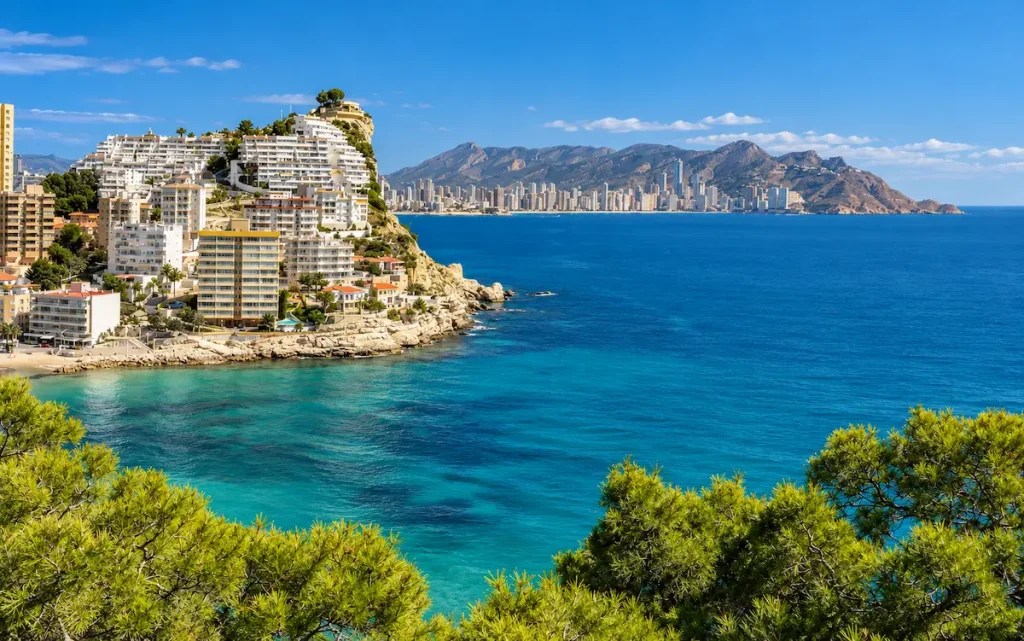
Finestrat is a town in two halves. The old town climbs a hillside beneath Puig Campana, the second-highest mountain in the province of Alicante, while a separate beach area, Cala de Finestrat, sits on the coast between Benidorm and Villajoyosa. Most visitors know only the beach, but the old town, a small museum and one of the coast’s toughest hikes are all in the same municipality. This guide covers each part, with the practical details that could be checked in September 2026.
Finestrat at a Glance
Finestrat is in the Marina Baixa, between Benidorm and Villajoyosa. It has about 9,900 residents, according to the 1 January 2025 official register, and only a short stretch of coast, around 267 metres.
Old town: inland, on a hillside below Puig Campana
Beach: Cala de Finestrat, the municipality’s only beach, bordered by Benidorm to the northeast and Villajoyosa to the southwest
Main hike: Puig Campana, from the Font del Molí trailhead
Museum: the Museu de Finestrat, in the old town
Languages: Valencian and Spanish
The Old Town
The old town is small and best explored on foot. Its streets date from the Moorish period, and it is known for its “casas colgantes”, houses that seem to hang from the hillside. The town’s core is built on a gypsum rock, which is why some streets are named after the gypsum workers.
The main landmarks are the Church of Sant Bertomeu, the Plaça de la Torreta beside it, and the Castell at the top of the old town. The castle itself no longer stands, but its site holds the small Ermita del Santísimo Cristo del Remedio, a viewpoint over the coast and Benidorm’s skyscrapers, and the open-air Auditori El Castell, which the town hall uses for summer events.
The name Finestrat is commonly translated as “window to the sea”. The town hall’s own guide to the area puts the old town and the beach in one municipality, so the two are easy to combine in a day.
Museu de Finestrat
The Museu de Finestrat is in the Parc Alcalde Miguel Llorca, in the historic centre. It combines a new building with an early 20th-century farmhouse, and it holds two permanent collections.
The ethnology collection, in the restored Font de Carré farmhouse, shows everyday life in the town over a century ago, with a focus on farming and esparto grass crafts, and an olive press. The archaeology collection, upstairs in the modern building, includes finds from the Iberian and Roman settlement at La Cala and from the Islamic period, along with plates and bowls from the 14th to 18th centuries recovered from the church crypt and the castle excavations. A ground-floor room hosts temporary exhibitions.
Tuesday to Saturday: 10:00 to 13:00
Friday: also 17:00 to 20:00
Sunday: 10:00 to 14:00
These hours are from the town hall’s website, checked in September 2026, and it lists no Monday opening. The page gives no admission price.
Puig Campana
Puig Campana is the second-highest peak in the province of Alicante after Aitana. Published heights range from 1,406 to 1,410 metres depending on the source, so it is best described as just over 1,400 metres. The mountain dominates the town’s skyline and is Finestrat’s biggest draw for walkers.
Most routes start at the Font del Molí, a recreational area with a car park and an information point, less than a kilometre from the village. From there, the marked PR-CV 289 “Volta al Puig Campana” circles the mountain.
Published routes to the summit differ in length and effort:
- Via the steep “Carreró” gully: about 11 km, roughly 1,050 m of ascent and about 5 hours, described as technical, with steep, loose ground
- Circular via the PR-CV 289: about 15 to 17 km, roughly 1,100 m of ascent and 5.5 to 7 hours
One local walking club grades the climb as high for physical effort and says it is not suitable for beginners. Parking at the Font del Molí can fill early, especially at weekends. The town hall runs a live webcam on Puig Campana, which is a useful weather check before setting out.
From the summit the views take in the coast to the east, the Sierra de Bernia to the north and Aitana to the northwest. For another mountain in the same area, see exploring Sierra Bernia, and for protected areas across the region, the guide to natural parks on the Costa Blanca.
Cala de Finestrat
Cala de Finestrat is a small, sandy urban beach of about 270 metres, closed in by the Tossal de la Cala hill to the north. It sits right next to Benidorm’s Poniente beach, which is why many visitors assume it belongs to Benidorm. Local sources say the coastal strip once belonged to Villajoyosa and was given to Finestrat in recognition of its help against pirates.
Older listings still describe the beach as a Blue Flag beach. It did not appear on the list of 2026 Blue Flags for the Valencian Community published in May 2026, so check before relying on that label. The town hall lists a seafront square, the Plaça de l’Àmfora, on the beach.
The coast on the Villajoyosa side is worth a look too. A local campsite describes a walk of around an hour and a half from El Torres in Villajoyosa, past the Racó del Conill cove and the Torre del Aguiló, toward Cala de Finestrat. See the guide to Villajoyosa’s beaches and coves for that stretch. For beaches on the other side, there are Benidorm’s beaches.
Fiestas
Finestrat’s main annual celebration is the patron fiesta for Sant Bertomeu (St Bartholomew), with 24 August given as the saint’s day. The regional tourism guide also lists the Día de la Ereta and the fiestas of Sant Antoni del Porquet and Sant Blai. Dates change from year to year, so check with the town hall before planning a visit.
Getting There
Finestrat sits between Benidorm and Villajoyosa, reached from Benidorm by the CV-767 and from Villajoyosa by the CV-759. The beach area is on the N-332. The old town and the beach are several kilometres apart, so a car or a taxi is the easiest way to combine them. The guide to public transport on the Costa Blanca covers what is available, and Alicante–Elche Airport is the main gateway.
For everything else on the town, see the Finestrat hub page. A short drive south, the complete guide to Villajoyosa covers the next town along the coast, and Guadalest is the classic inland day trip from the same area.